The best grow light for starting seeds indoors is the Spider Farmer GlowBar 40W 4-bar kit — low heat, IP65 waterproof, and purpose-sized for standard 10×20 inch seed trays with the blue-enriched spectrum (5000K + 3000K) seedlings need most. For a budget option that gets the job done across a full shelf, the Barrina T5 LED 4-pack (6500K, linkable) is the most widely recommended starting point. For growers who want a dimmable panel that transitions seedlings all the way through early veg, the Spider Farmer SF1000 EVO at 2.7 µmol/J with three-level dimming is the step-up pick.
Seedlings have different light needs than mature plants. They need 100–300 µmol/m²/s PPFD — far less intensity than adult flowering plants — over long photoperiods (14–18 hours/day), with a blue-enriched spectrum around 5000–6500K to prevent stretching. Too much light or heat causes stress; too little produces leggy, weak seedlings that struggle at transplant. The picks below are matched to tray footprint, safe PPFD at hanging height, and the spectrum requirements of germination through transplant readiness. For grow lights covering all plant stages, see our complete grow lights guide.
At a Glance: Best Grow Lights for Seedlings 2026
| # | Product | Award | Watts | Spectrum | Price |
|---|---|---|---|---|---|
| 1 | Barrina T5 LED 4-Pack | Best Budget | 80W total | 6500K | $ |
| 2 | Spider Farmer GlowBar 40W | Best Seedling Strip | 40W | 5000K+3000K | $$ |
| 3 | GooingTop 80W LED (3-Head) | Best Clip-On | 80W | 6000K+3000K | $ |
| 4 | MARS HYDRO TS 600 | Best Budget Panel | 100W | Full-spectrum | $ |
| 5 | VIVOSUN VS1000 | Best Compact All-Rounder | 100W | Full-spectrum | $ |
| 6 | SunBlaster T5HO 24″ | Best T5 Fluorescent | 24W | 6400K | $ |
| 7 | Spider Farmer SF1000 EVO | Best Performance Panel | ~100W | LM301H EVO | $$ |
| 8 | Spider Farmer 3ft LED Strip Kit | Best Multi-Tier Setup | 200W (rack) | Full-spectrum | $$ |
| 9 | Agrobrite T5 2-Lamp 2ft | Best Traditional T5 | 24W | 6400K | $$ |
| 10 | MARS HYDRO TS 1000 | Best Step-Up Panel | 150W | Full-spectrum | $–$$ |
How We Chose These Seedling Grow Lights
We selected based on: coverage of a standard 10×20 inch seed tray or equivalent; spectrum suitability (5000–6500K blue-enriched); documented PPFD in the 100–300 µmol/m²/s seedling range at appropriate hanging heights; heat output (low is critical for propagation environments with humidity domes); dimming availability; and price-band value. All products CPSC-screened at recalls.gov — no open recalls found (July 2026). No physical testing conducted. Author: Michael Probert.
Best Grow Lights for Seedlings Reviewed
Transparency first: This guide contains affiliate links. If we’re enrolled in an affiliate program, we may earn a commission at no extra cost to you — it never affects how we research or rank. Read our full affiliate disclosure policy.
Barrina T5 LED Grow Light Strips (4-Pack, 6500K) — Best Budget Seedling Light
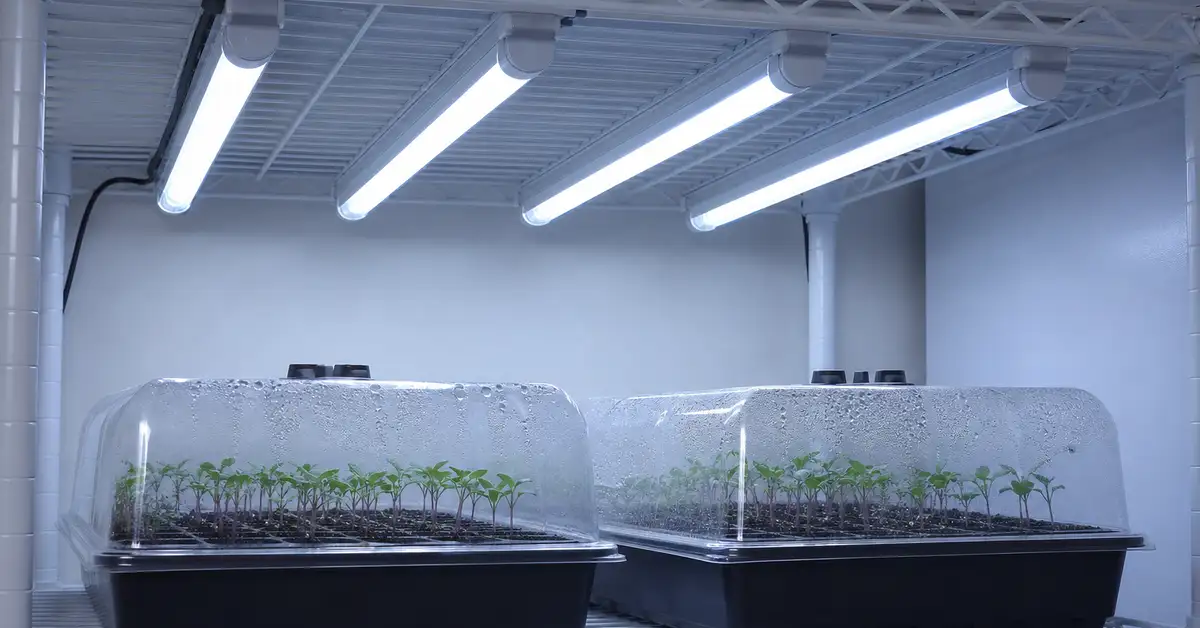
T5 LED bars · 20W per bar (80W total) · 6500K cool white · Coverage: 4 × 10×20 inch trays · Linkable design · IP44 · Price band: $
Barrina’s T5 LED grow light strips are the default recommendation for budget seed-starting, and for good reason: 6500K delivers the blue-heavy spectrum that prevents seedling stretch, the bars are sized for standard 10×20 inch trays, and the linkable daisy-chain design lets you cover multiple shelf tiers from a single outlet. Each bar draws 20W; a 4-pack totals 80W across four trays. Heat output is genuinely low — both reviewers and manufacturer documentation note “no heat buildup,” making these safe to mount close to seedlings under humidity domes without risk of foliage burn. No built-in timer or dimmer, but they’re compatible with any standard plug-in timer. For a first-time indoor seed-starter on a budget, Barrina T5 LEDs are the entry point.
Pros: Budget price; 6500K blue-enriched spectrum; linkable/chainable; sized for 10×20 inch trays; minimal heat; widely available. Cons: No dimmer or timer; single spectrum (no warm-white for veg transition); multiple bars required for larger setups.
Spider Farmer GlowBar 40W 4-Bar Kit — Best Purpose-Built Seedling Strip System
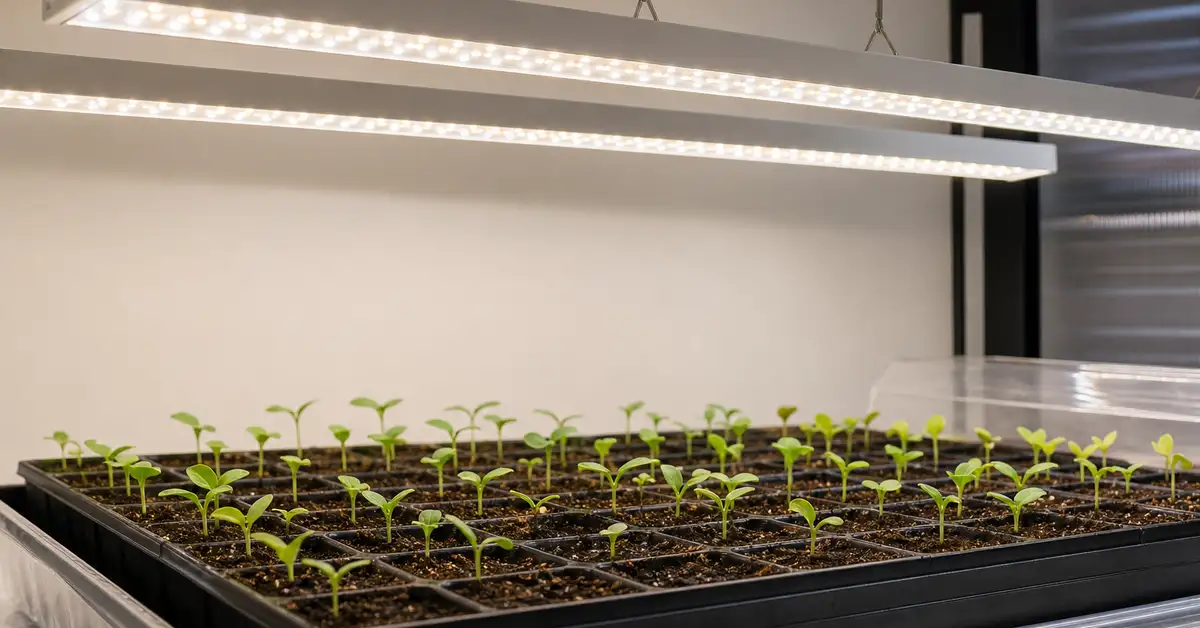
Spider Farmer seedling strips · 40W (4-bar kit) · 5000K + 3000K dual-channel · IP65 waterproof · Coverage: 1–2 standard trays per bar · Linkable up to 11 bars · Price band: $$
The Spider Farmer GlowBar is designed specifically for the propagation environment. Where Barrina’s 6500K single-spectrum is functional, the GlowBar’s 5000K + 3000K dual channel delivers a broader seedling-to-early-veg spectrum — the cool channel prevents stretch during germination; the warm channel supports early root and stem development. IP65 waterproofing protects LED beads in high-humidity dome environments, a meaningful advantage over non-rated competitors. Spider Farmer’s documentation emphasises “gentle, stable illumination that wakes up plants without heat or light intensity stress” — accurate for a 40W low-heat design. Daisy-chain supports up to 11 bars in series; mounting clips, ties, and cables included. For growers who want purpose-built seedling hardware with better humidity protection than generic strips, the GlowBar is the step up.
Pros: Purpose-built for propagation; IP65 waterproof; dual 5000K+3000K channel; daisy-chain scalable; low heat; beginner-friendly installation. Cons: $$ vs. Barrina’s $; no built-in timer; 40W limits per-tray intensity vs. panels.
GooingTop 80W LED Grow Light (3-Head, 6000K) — Best Clip-On for Seedlings
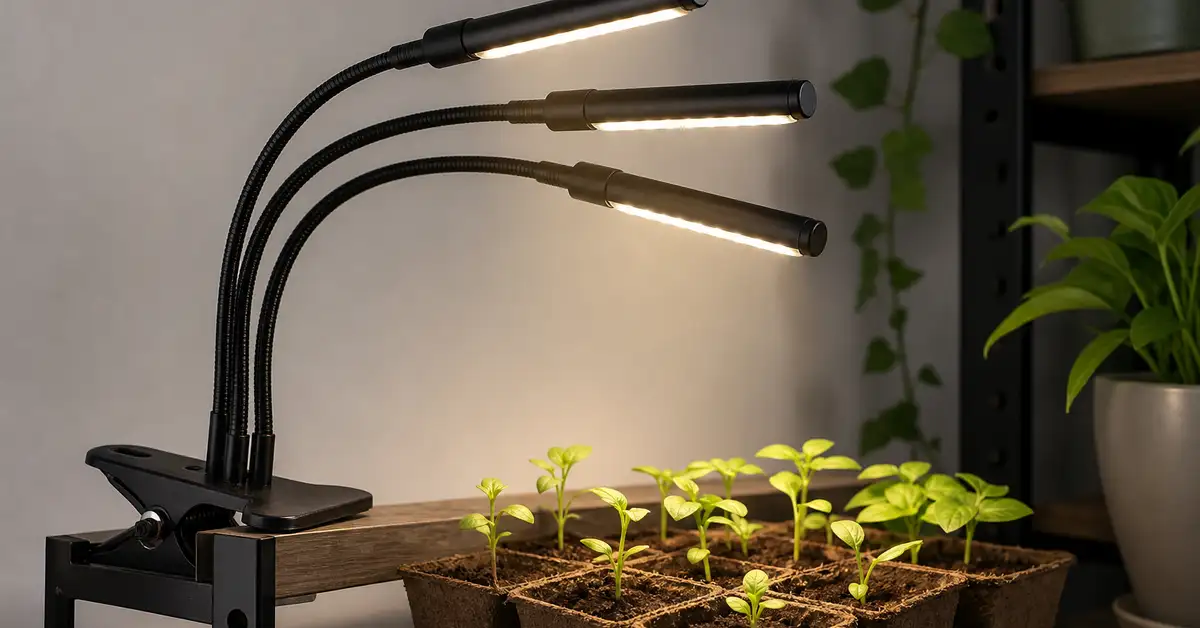
3-head gooseneck LED · ~80W · 6000K + 3000K full-spectrum · Built-in timer (4/8/12h) · Clip-on mount · Price band: $
The GooingTop clip-on is the go-to for growers starting seeds in small batches without a dedicated shelf or rack. Three independently adjustable gooseneck heads allow you to aim light precisely at individual trays or pots, and the built-in 4/8/12-hour timer removes the need for a separate plug-in timer. 6000K + 3000K dual-spectrum covers the blue-enriched range seedlings need while adding a warm component. At 80W with three heads, PPFD at 15–30 cm above the canopy is in the seedling-appropriate range when a single head is used per tray. No rack or mounting required — clips to any shelf, table, or window ledge.
Pros: Built-in timer; no rack needed; 3 adjustable heads; budget price; covers 3 trays simultaneously. Cons: Less even coverage than strip lights; individual heads concentrate PPFD in small spots; not IP-rated for humid environments.
MARS HYDRO TS 600 — Best Budget Full-Spectrum Seedling Panel
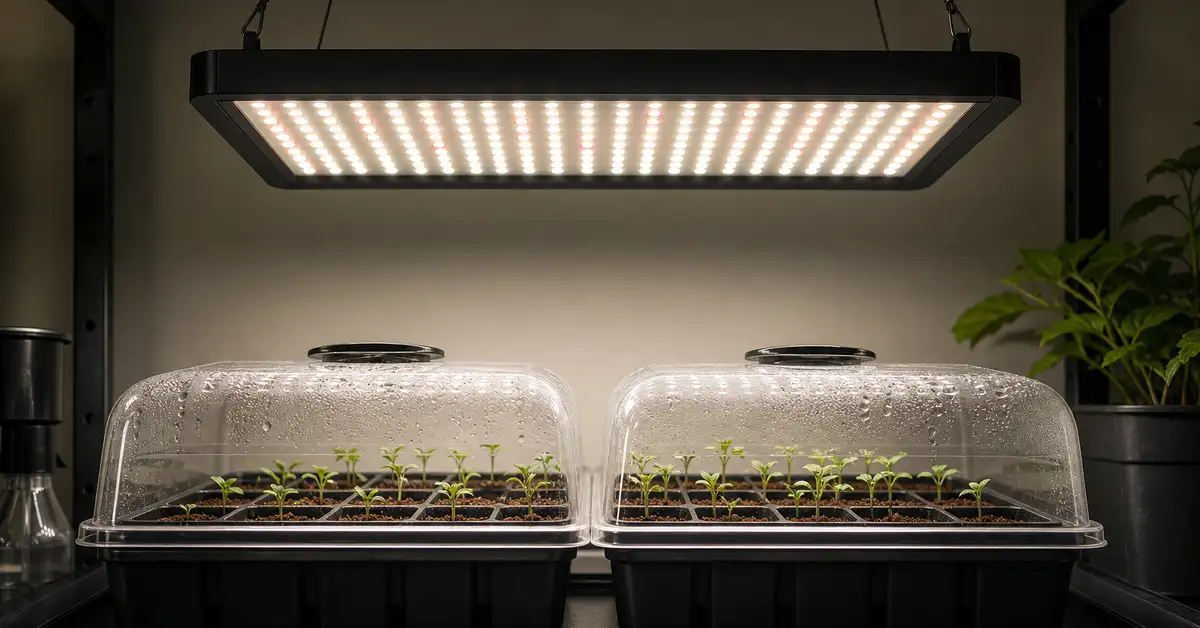
Full-spectrum board · 100W true draw · Coverage: 2×2 ft · Full-spectrum diode mix · Dimmable: yes · Price band: $
The MARS HYDRO TS 600 is the entry-level panel for growers transitioning from strip lights to a compact full-spectrum board. At 100W with dimmable output, it covers a 2×2 ft space — enough for a 2×2 grid of 10×20 inch trays. The full-spectrum diode mix suits both germination and vegetative transition, and dimming lets you back off to seedling-safe PPFD levels (run at 50% or lower during germination). At $ pricing, it’s the most accessible standalone panel for seedlings. For a first grow tent setup used for both seed starting and early veg, the TS 600 is a practical dual-purpose choice.
Pros: Budget panel price; full-spectrum; dimmable; 2×2 ft coverage for tray arrays; transitions seedlings to veg. Cons: Run at reduced power for early seedlings to avoid intensity stress; panel format less flexible than strips for multi-shelf setups.
VIVOSUN VS1000 — Best Compact Panel All-Rounder
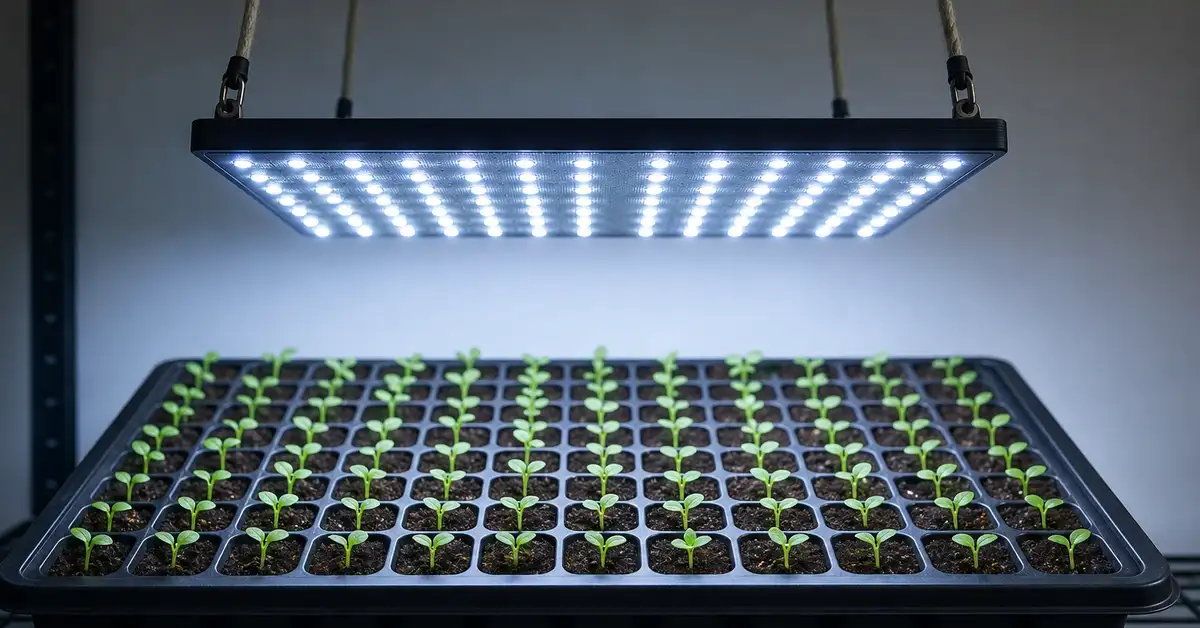
Full-spectrum board · 100W true draw · Coverage: 2×2 ft · White/red/far-red diode mix · Dimmable: yes · Price band: $
The VIVOSUN VS1000 competes directly with the MARS HYDRO TS 600 at the same $ price tier and 2×2 ft footprint. The VS1000 adds warm-white and far-red diodes alongside standard white, giving it a slightly richer spectral profile. At 100W dimmable, it’s right-sized for a 4-tray seed-starting array when dialled back to 50–75% during germination. VIVOSUN’s ecosystem integration (compatible with their grow tents and controllers) makes it a natural fit for growers who already use VIVOSUN gear. For a first-time buyer choosing between VS1000 and TS 600: both are strong, the VS1000 has the broader diode mix.
Pros: Full-spectrum with warm-white + far-red; dimmable; 2×2 ft coverage; budget price; VIVOSUN ecosystem compatible. Cons: VIVOSUN customer support is variable; similar to TS 600 — difference is marginal at this price tier.
SunBlaster T5HO 24-inch (24W, 6400K) — Best T5 Fluorescent for Germination
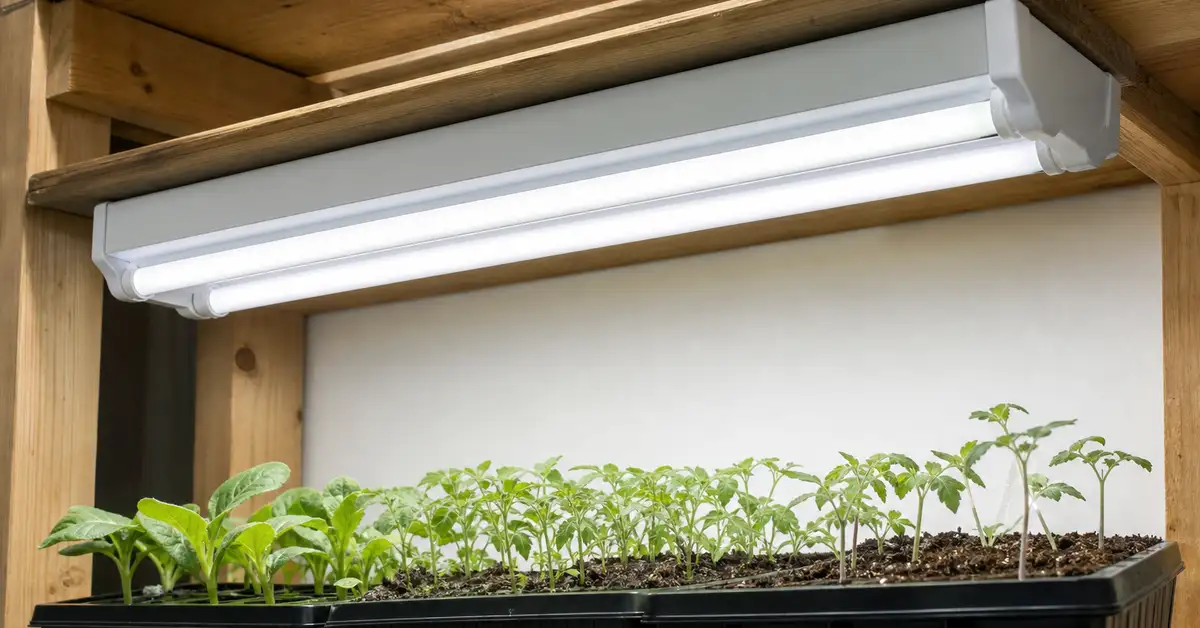
T5 High Output fluorescent · 24W · 6400K natural daylight · Full-spectrum phosphor coating · Coverage: 1–2 trays at 2–4″ · Price band: $
SunBlaster’s T5HO remains the traditional benchmark for seed-starting. The 6400K spectrum closely approximates natural daylight — the cool white favoured by germination guides for decades — and the HO (High Output) tube delivers more light per watt than standard T5 fluorescents. At 2–4 inches above the canopy, the T5HO covers one to two 10×20 inch trays adequately in the seedling PPFD range. T5 fluorescent tubes degrade over time (brightness drops ~15% after 6,000 hours), so replacement timing matters. SunBlaster tubes use a proprietary nano-reflector design that directs more lumens downward. For growers who prefer tried-and-true fluorescent technology over LEDs, or who already have SunBlaster fixtures, the T5HO 24″ is the proven standard.
Pros: 6400K proven seed-starting spectrum; established technology; works at 2–4″ from canopy; SunBlaster nano-reflector for efficiency. Cons: Fluorescent tubes degrade and need replacement (~6,000 hours); less energy-efficient than modern LED alternatives; limited dimming.
Spider Farmer SF1000 EVO — Best High-Performance Seedling Panel
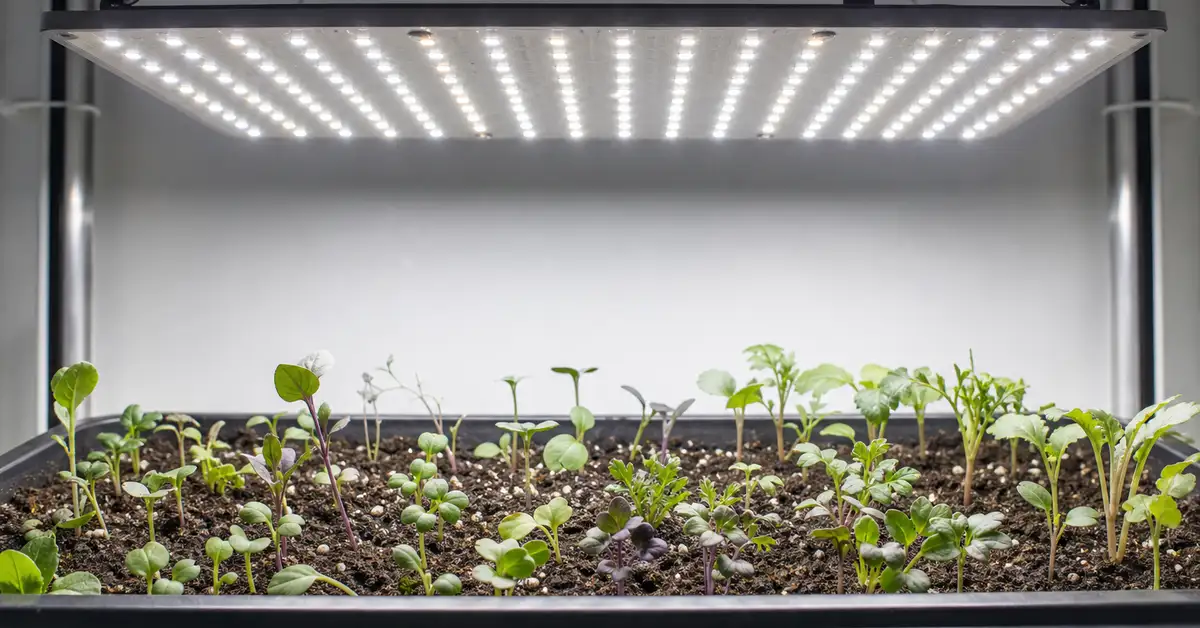
Samsung LM301H EVO diodes · ~100W · 2.7 µmol/J efficacy · 3-level dimming (100%/50%/10%) · Coverage: 2×2 ft bloom / 3×3 ft veg · GGS controller compatible · Price band: $$
The Spider Farmer SF1000 EVO stands out for seedling use specifically because of three-level dimming to 10% — the ability to run at 10% of rated power is ideal for germination through first true leaves, keeping PPFD in the 100–150 µmol/m²/s range without raising the light. The LM301H EVO diodes (2.7 µmol/J) deliver full-spectrum quality that carries plants through seedling, veg, and into early flowering. This is the panel for growers who want one light that starts seeds, grows out transplants, and continues into a small tent or shelf grow. GGS controller compatible for automated dimming schedules. Fanless; no noise in propagation rooms.
Pros: 10% dimming setting ideal for germination; Samsung LM301H EVO quality; 2.7 µmol/J; GGS controller compatible; fanless; transitions seedlings all the way through veg. Cons: $$ investment for a seedling light if not being used beyond that stage; verify EVO SKU at purchase (standard SF1000 has different diodes).
Spider Farmer 3ft Dimmable LED Strip Plant Stand Kit — Best Multi-Tier Seedling Setup
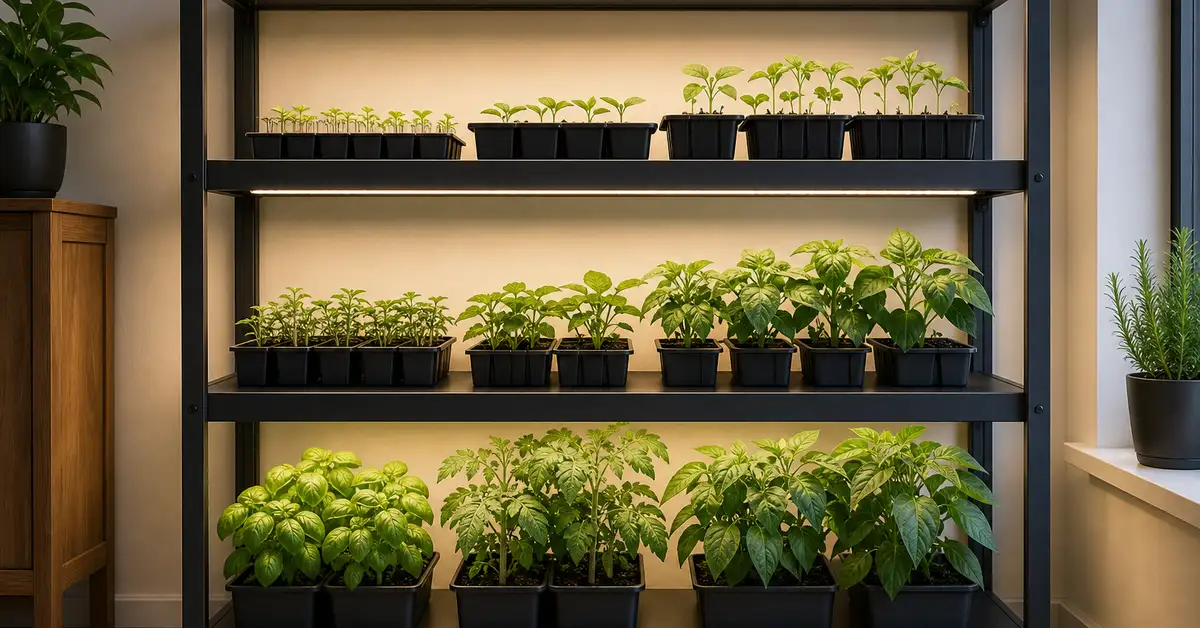
Full-spectrum bars · 200W total (multi-bar rack) · 3-level dimming (100%/50%/10%) · 5000–5500K + 3000–3500K + 660 nm · IP65 · Daisy-chain up to 11 bars · Price band: $$
Spider Farmer’s 3ft dimmable LED strip kit is designed for growers starting seeds at scale — multiple tiers, many trays. A 200W plant stand configuration spans multiple shelves, with 1296 LEDs covering several trays per tier. The three-level dimming (10%/50%/100%) lets you match intensity to seedling age across different tiers. IP65 waterproofing suits humid propagation environments. At 200W total power, careful intensity management is required during early seedling stages — start at 10% and increase as true leaves develop. For a dedicated seed-starting rack that can grow with your production, this system is the most scalable option on this list.
Pros: IP65 waterproof; 3-level dimming; scalable (daisy-chain up to 11 bars); multi-tier coverage; 5000K + 3000K + 660nm spectrum. Cons: $$+ investment for the full rack configuration; 200W total requires intensity management during early germination; no built-in timer.
Agrobrite Designer T5 2-Lamp 2-Foot — Best Traditional T5 Fixture
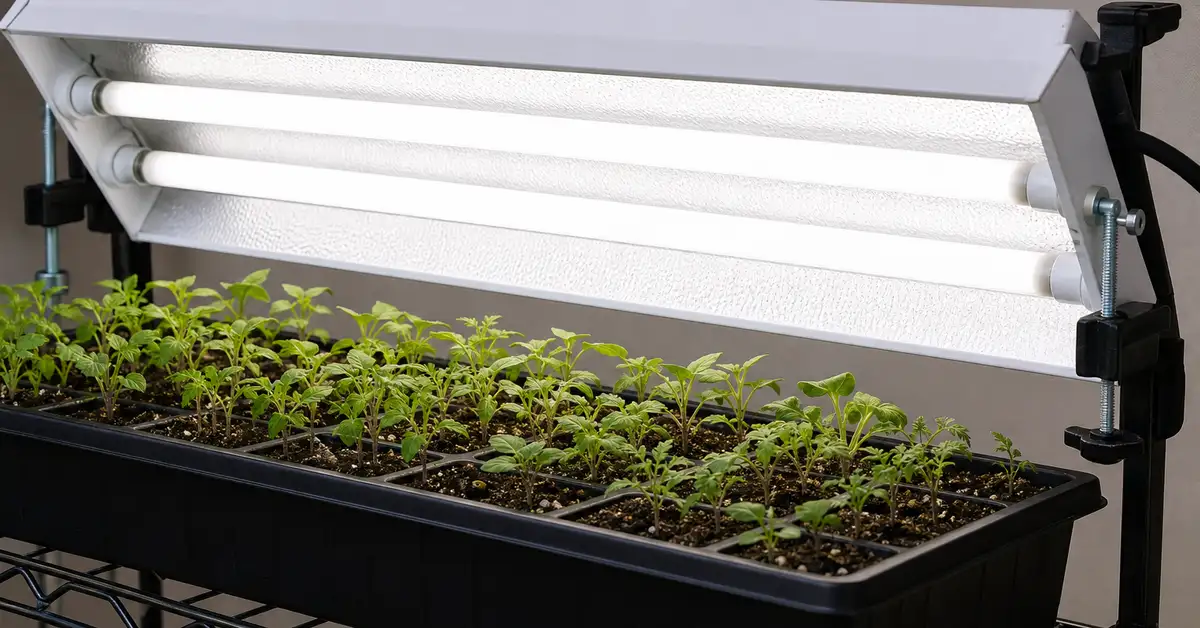
T5 fluorescent fixture (2 × 24W tubes) · 48W · 6400K · Fixture + 2 tubes included · Coverage: ~2ft × 1ft per bar · Adjustable hanging · Price band: $$
Agrobrite’s Designer T5 is a full T5 fluorescent fixture — frame, reflector, and tubes included — built for seed starting and propagation. Two 24W 6400K tubes provide even coverage across a 2-foot span. The angled reflector maximises downward photon delivery; the adjustable hanging chains allow height adjustment as seedlings grow. A more complete out-of-the-box solution than single SunBlaster tubes, at a modest additional cost. For growers who want a purpose-built T5 fluorescent setup (not just tubes) without committing to LED panels, the Agrobrite Designer T5 is the most complete seedling-ready fluorescent fixture in the $–$$ price range.
Pros: Complete fixture (frame + tubes + reflector); 6400K seed-starting spectrum; even coverage; adjustable hanging; proven T5 technology. Cons: Tubes degrade over time and need replacement; less energy-efficient than LEDs; heavier and bulkier than strip alternatives.
MARS HYDRO TS 1000 — Best Step-Up Panel (Seedlings to Veg)
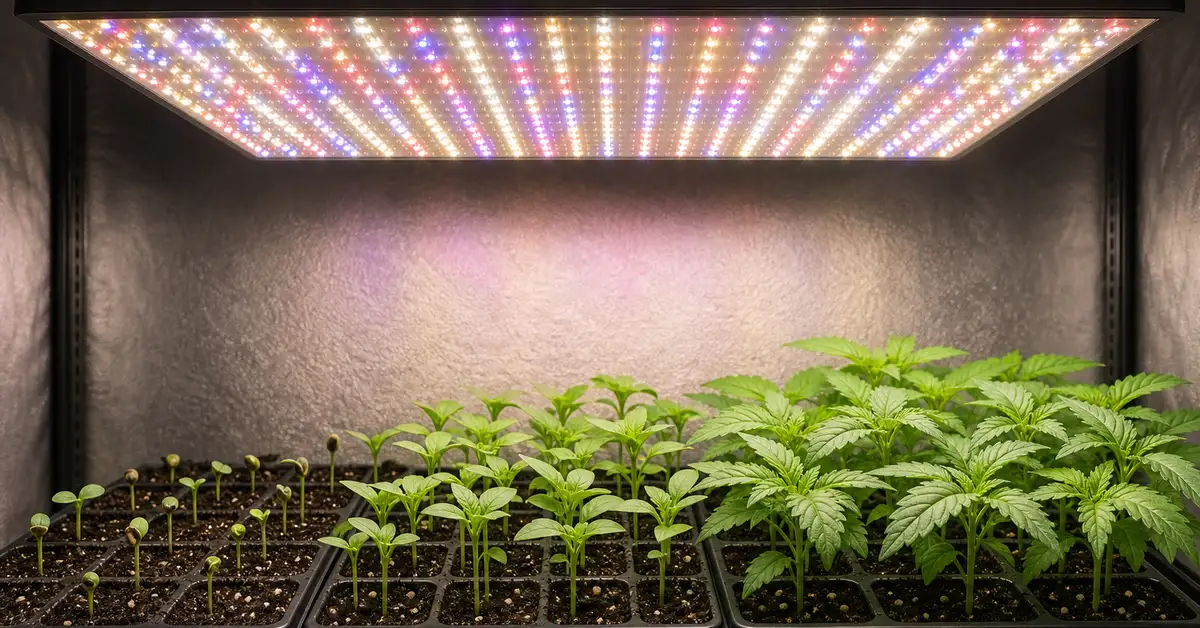
Full-spectrum board · 150W true draw · Coverage: 2×2 ft bloom / 3×3 ft veg · Dimmable: yes · Price band: $–$$
The MARS HYDRO TS 1000 is for growers who want a seedling-capable light that won’t be outgrown as plants transition to veg and flower. At 150W with dimmable output, it covers the same 2×2 ft footprint as the TS 600 at seedling stage (run at 30–40% during germination), then scales up to full power for vegetative growth. Mars Hydro’s full-spectrum diode mix covers the complete PAR range. The TS 1000 is the most popular starting-point panel in the Mars Hydro line — a known quantity with strong community support and widely available documentation for optimal height and intensity settings.
Pros: Full-spectrum dimmable; covers seedlings through veg and flower; 2×2 ft footprint; large community + support documentation; strong value at $–$$. Cons: 150W panel can overwhelm very early seedlings if not dimmed; slightly more investment than the TS 600 for growers who only need seedling capability.
Seedling Grow Light Buying Guide
Why Seedlings Need Different Light Than Adult Plants
Seedlings are more light-sensitive than mature plants in two directions — too much and too little both cause problems. Too little light produces leggy, etiolated seedlings with weak stems that struggle at transplant. Too much intensity, especially from powerful panels close to the canopy, causes bleaching, curling, and moisture stress (lights + heat mats combined dry seed-starting mix quickly). The target range: 100–300 µmol/m²/s PPFD, rising gradually from germination through first true leaves. This is far less than the 400–800 µmol/m²/s an adult plant in veg typically needs. Strip lights and T5s are purpose-matched to this low-intensity requirement; compact panels need to be dimmed significantly.
Blue Spectrum (5000–6500K) vs Full-Spectrum: Which Is Better for Seeds?
For germination and early seedling development, a cool white spectrum (5000–6500K) with high blue-photon content is the established recommendation. Blue light (450–500 nm) promotes compact internodes, shorter stems, and dense root systems — preventing the stretching that is the most common seedling problem under inadequate light. Full-spectrum lights that include both cool white and warm white channels (3000K + 5000K) work well for seedlings when the cool channel dominates during early stages. Single-spectrum warm-white lights (2700–3000K) are better suited to flowering plants and are not ideal for seed starting.
T5 Fluorescent vs LED Strips for Seed Starting
Both work well, with trade-offs. T5 fluorescent (6400K) has decades of proven performance for seed starting — the spectrum is good, the intensity is controllable by distance, and the technology is widely documented. Disadvantages: tubes degrade over time (~6,000 hours), generate slightly more heat than LEDs, and are less energy-efficient. LED strips (6500K or 5000K + 3000K dual-channel) maintain brightness longer, produce less heat, and are more energy-efficient. In 2026, LED strips have largely replaced T5 fluorescents for most home seed-starters, but T5 remains valid for growers with existing fluorescent fixtures.
How Close Should Grow Lights Be to Seedlings?
Strip lights and T5 bars: 2–6 inches above the canopy during germination; raise gradually as seedlings grow. Compact panels (100–150W): typically 18–24 inches above the canopy at 50–75% power during seedling stages — closer at lower power settings. Adjust by observing seedling behaviour: if stems stretch upward, the light is too far or too dim; if leaves curl, bleach, or show stress, the light is too close or too bright. Seedlings grown with humidity domes should have the light positioned to avoid overheating the enclosed air space.
Frequently Asked Questions
How many hours of light do seedlings need per day?
14–18 hours per day is the standard recommendation for most vegetable and herb seedlings. Unlike adult plants, which sometimes benefit from distinct photoperiods, seedlings generally tolerate long exposure times and benefit from the extended light to compensate for lower intensity. Use a plug-in timer to maintain consistency. Seedlings also need a dark period (6–10 hours) for respiration — avoid 24-hour lighting.
Can I start seeds under a regular LED light bulb?
Standard household LED bulbs can support germination in a pinch but are not optimised for seedling growth. They produce insufficient PPFD at typical lamp distances, and the spectrum often skews warm (2700K) rather than the cool blue-enriched range (5000–6500K) seedlings need. A purpose-built T5 strip, LED grow bar, or compact grow panel will produce stronger seedlings. For a low-commitment starting point, the Barrina T5 LED 4-pack at $ delivers far better results than repurposed household bulbs.
Do I need to harden off seedlings grown under grow lights before transplanting?
Yes. Seedlings grown under artificial light indoors are adapted to constant, low-to-moderate intensity. Direct outdoor sun can easily reach 2,000–10,000 µmol/m²/s — far beyond the 100–300 µmol/m²/s they experienced indoors. Hardening off (gradually introducing outdoor conditions over 7–14 days) prevents transplant shock, sunscald, and stem damage. Start with 1–2 hours of filtered outdoor light and increase daily.
What PPFD do seedlings need?
100–300 µmol/m²/s is the target range for most seedlings from germination through transplant readiness. Start closer to 100 µmol/m²/s at germination (or even lower for light-sensitive species) and increase toward 200–300 µmol/m²/s as true leaves develop. A light meter (or a grow light app) is the most reliable way to verify PPFD at the canopy — hanging height alone is not sufficient to gauge intensity, as wattage and optics vary significantly between fixtures.
More from Planted Indoors
- Best Grow Lights of 2026: All Types Compared
- Best Full-Spectrum Grow Lights of 2026
- Best Grow Lights for Herbs & Greens
- Best Grow Lights for Small Spaces
- Best LED Grow Lights of 2026
This post was researched and written by Michael Probert. No physical product testing was conducted. Picks are based on manufacturer specifications, research publications, and current 2026 market data. All products CPSC-screened at recalls.gov (July 2026) — no open recalls found.